April,25,2025
In a bold and unprecedented move, India has suspended the decades-old Indus Waters Treaty (IWT) with Pakistan — a decision that’s sparking serious questions across the region: Can India really stop river water from flowing into Pakistan?
The announcement came in the wake of a deadly militant attack in Indian-administered Kashmir, which New Delhi claims was supported by Pakistan-based groups — an accusation Islamabad strongly denies. India has since taken several retaliatory steps, and suspending the IWT is among the most significant.
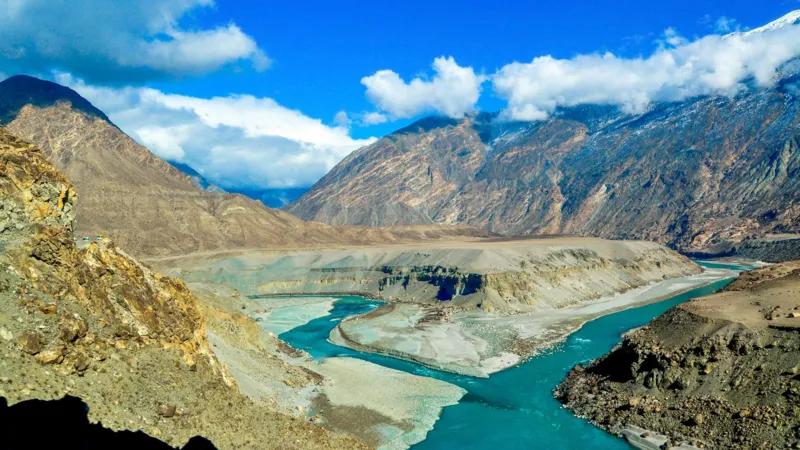

What Is the Indus Waters Treaty?
Signed in 1960 and brokered by the World Bank, the IWT is considered one of the world’s most successful water-sharing agreements, having withstood wars and long-standing political tensions. It divides the six rivers of the Indus basin between the two neighbors.
India was granted control over the three eastern rivers — Ravi, Beas, and Sutlej — while Pakistan received the three western ones — Indus, Jhelum, and Chenab — which together supply about 80% of Pakistan’s water for agriculture and hydropower.
What Does the Suspension Mean?
While the treaty has been under strain before, this is the first time either country has formally stepped away from it. As the upstream nation, India holds a geographic advantage — but experts say halting water flow is far more complicated than it sounds.
Most of India’s water infrastructure on the western rivers is based on run-of-the-river hydropower technology, which generates electricity using flowing water but doesn’t involve large-scale storage. That means India currently lacks the massive reservoirs or canal networks required to divert or block the huge volumes of water that flow into Pakistan — especially during the monsoon season.






So, Can India Stop the Flow?
Not entirely — at least not for now.
Experts agree that India doesn’t have the capacity to stop tens of billions of cubic metres of water from reaching Pakistan, especially during high-flow seasons. However, the real concern is what happens during the dry months, when every drop of water becomes crucial.
By suspending the treaty, India is no longer required to share plans or data with Pakistan for new water projects. This opens the door for India to build or modify dams and reservoirs to store more water during dry seasons — potentially reducing flow into Pakistan just when it’s needed most.
Impact on Pakistan
Pakistan has warned that cutting off river water would be seen as an “act of war.” The country’s economy and food security are heavily reliant on the Indus basin, with over 80% of its agricultural activity depending on these rivers.
There are also growing concerns about flood forecasting. The treaty requires India to share hydrological data — especially during the flood-prone monsoon season. Without this, Pakistan may be left in the dark during emergencies. However, Pakistani officials claim that even before the suspension, India was sharing limited data.

Could India “Weaponize” Water?
The idea of “weaponizing” water — using it as a strategic tool or even a threat — isn’t new. Some worry that India could release water suddenly to flood downstream areas or flush silt without warning, causing damage to Pakistan’s irrigation systems.
But most experts caution that such tactics could also backfire, flooding India’s own territories since most Indian dams aren’t located close to the border.
A Bigger Regional Puzzle
The issue of water politics doesn’t end at India and Pakistan. The Indus originates in Tibet, and India itself is downstream of China on the Brahmaputra River. After a similar militant attack in 2016, China had briefly blocked a tributary of the Brahmaputra, raising strategic alarms in Delhi.
China is now building what could be the world’s largest dam on the Yarlung Tsangpo (which becomes the Brahmaputra in India), giving it potential control over water flows that India depends on — making India’s own position as a downstream country precarious.
Final Thoughts
India’s suspension of the Indus Waters Treaty is a major turning point in South Asia’s water diplomacy. While India may not be able to cut off water flows to Pakistan entirely, its decisions could still have significant impacts, especially during dry seasons.
This crisis highlights just how vital — and vulnerable — water resources are in this already fragile region. As political tensions rise, millions of lives that depend on these rivers hang in the balance.